Cross-Linked (XLPE) vs. Non-Cross-Linked EPE Foam Specifying: Surface Hardness, Cell Size, and Resiliency Comparison
1. Introduction: The Foam Specification That Determines Whether Your Product Arrives Intact
I have been specifying protective foam for industrial packaging for over a decade, and I can tell you that the most expensive foam decision is not choosing the wrong density. It is choosing the wrong foam chemistry for the application's load profile.
Here is what that looks like in practice. A manufacturer packages a precision optical instrument in an EPE foam insert because EPE is lightweight, cost-effective, and easy to die-cut. The insert looks good in the sample. The first shipments arrive intact. But over the next six months, the customer reports that the instruments are arriving with misaligned optics. The root cause, after a lengthy investigation, is off-gassing. The chemically cross-linked foam used in the insert was releasing trace volatile organic compounds that condensed on the optical surfaces inside the sealed packaging. The foam did its job as a cushion. It failed as a packaging material because nobody asked what was coming off it.
The problem is not that EPE is a bad foam. It is the workhorse of the protective packaging industry for good reason — lightweight, cost-effective, and excellent for cushioning fragile items. The problem is that the specification was based on mechanical properties alone. The off-gassing risk, the density variation, and the compression set behavior were never evaluated.
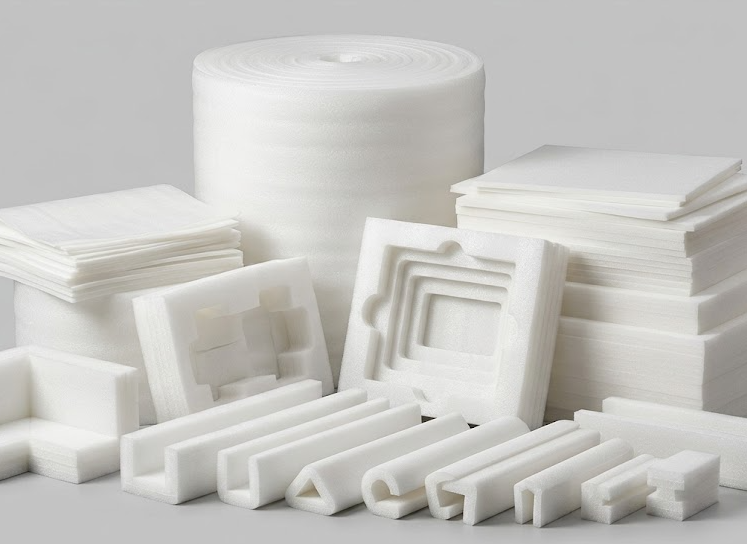
XLPE and EPE are both polyethylene foams. They come from the same base resin. But the manufacturing process is fundamentally different, and that difference cascades into every performance metric — surface hardness, cell size, resiliency, density uniformity, and off-gassing. This guide breaks down the two foam chemistries and matches each one to the application requirement.
2. What Cross-Linking Actually Does to Polyethylene
The difference between XLPE and EPE starts at the molecular level.
XLPE (Cross-Linked Polyethylene) is produced by chemically or physically cross-linking the polyethylene polymer chains. The cross-linking creates covalent bonds between the polymer chains, forming a three-dimensional network. This network structure is what gives XLPE its superior mechanical properties — high durability, resistance to permanent deformation, and a fine, uniform cell structure. The cross-linking also increases the melt strength of the polymer, which allows it to be foamed into a closed-cell structure with a high percentage of closed cells (≥95%).
EPE (Expanded Polyethylene) is produced by expanding low-density polyethylene beads using a physical blowing agent. The beads are heated, the blowing agent expands, and the beads fuse together to form the foam block. The polymer chains are not cross-linked. The cell structure is semi-closed, typically 60–80% closed cells, with a cell size of 0.25–0.35 mm. The non-cross-linked structure makes EPE lighter, more flexible, and less expensive to produce — but also less durable and more prone to permanent deformation under sustained load.
Parameter | XLPE | EPE |
Polymer structure | Cross-linked 3D network | Linear, non-cross-linked |
Cell structure | Closed-cell (≥95%) | Semi-closed (60–80%) |
Cell size | 0.1–0.3 mm (fine, uniform) | 0.25–0.35 mm |
Manufacturing | Chemical or radiation cross-linking + foaming | Bead expansion + fusion |
3. Surface Hardness: Shore C and Compression Deflection Data
The surface hardness of a foam determines how it distributes load and how it feels in the hand. Shore C is the standard durometer scale for measuring foam hardness, and the data tells a clear story.
XLPE hardness ranges from Shore C 18 to 72 depending on density. A low-density XLPE at 25 kg/m³ measures approximately Shore C 18. A high-density XLPE at 144 kg/m³ measures Shore C 72. The relationship between density and hardness is linear and predictable. For typical packaging applications, XLPE at 33–50 kg/m³ measures Shore C 25–45.
EPE hardness ranges from Shore C 15 to 25 for standard packaging grades. A 25 kg/m³ EPE measures approximately Shore C 18–20. The hardness is lower than XLPE at comparable density because the non-cross-linked structure is softer and more compressible. Even at higher densities, EPE does not reach the hardness of XLPE because the bead-fused structure lacks the molecular network that resists deformation.
Compression deflection is the more application-relevant metric. It measures the force required to compress the foam to a specified percentage of its thickness. XLPE at 33 kg/m³ requires 39 kPa to compress 25% and 69.6 kPa to compress 40%. EPE at 18–25 kg/m³ requires 0.52–1.6 kg/cm² (approximately 51–157 kPa) to compress 25% — but this is measured on a 25mm thick cylinder, and the test conditions differ from the XLPE ISO 3386-1 method. For 10% deflection, EPE at 25 kg/m³ requires only 0.20 kg/cm² (approximately 20 kPa).
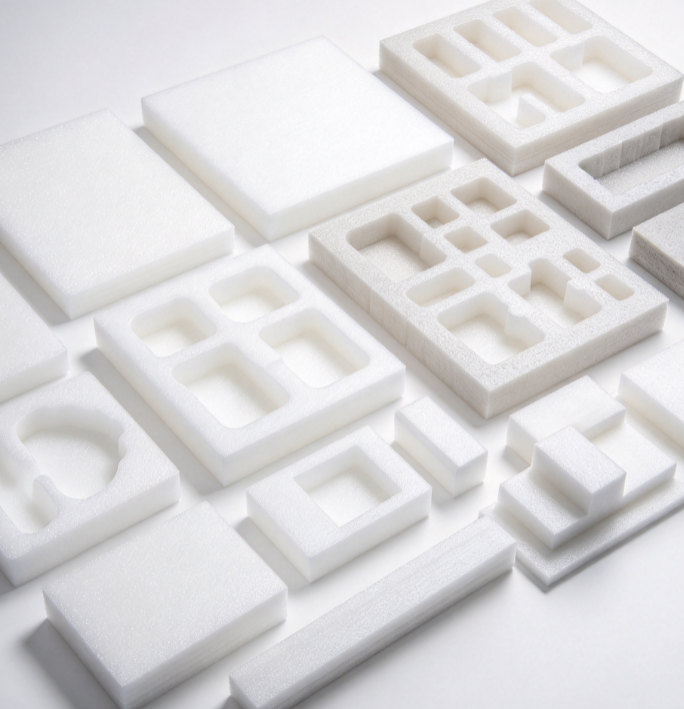
The practical interpretation is that XLPE is harder and stiffer for a given density. EPE is softer and more conformable. For applications where the foam must hold its shape under load — case inserts, returnable trays, structural packaging — XLPE is the correct specification. For applications where the foam must conform to the product and absorb shock, EPE is the correct specification.
4. Cell Size and Structure: The Microscopic Difference That Drives Performance
The cell structure is the microscopic architecture that determines how the foam behaves under load.
XLPE cell structure. XLPE has a fine, uniform closed-cell structure with a cell size of approximately 0.1–0.3 mm. The cross-linking process creates a high melt strength that allows the foam to expand uniformly, producing a dense network of small, thin-walled cells. The high closed-cell content (≥95%) means the foam resists water absorption and provides excellent thermal insulation. The uniformity of the cell structure also means the density is consistent from surface to core — typically within ±5% of nominal.
EPE cell structure. EPE has a semi-closed cell structure with a cell size of 0.25–0.35 mm. The cells are formed by the expansion of individual beads, and the boundaries between beads are visible in the foam structure. The cell walls are thicker than XLPE, and the cells are less uniform in size and shape. The density of EPE is uniform throughout the block because the beads are pre-expanded to a controlled density before fusion.
The cell size difference has a direct effect on surface finish. XLPE's fine cells produce a smooth, almost skin-like surface that is suitable for direct contact with painted or polished products. EPE's larger cells produce a slightly rougher surface that may leave a pattern on soft materials under high compression.
Cell Parameter | XLPE | EPE |
Cell type | Closed-cell (≥95%) | Semi-closed (60–80%) |
Cell size | 0.1–0.3 mm | 0.25–0.35 mm |
Cell uniformity | High — uniform throughout | Moderate — bead boundaries visible |
Surface finish | Smooth, skin-like | Slightly textured |
Water absorption | Very low (<0.001 g/cm³) | Low (0.03 mg/cm²) |
5. Resiliency and Compression Set: How Each Foam Recovers
Resiliency is the foam's ability to return to its original thickness after the load is removed. It is measured by compression set — the percentage of permanent deformation that remains after a specified compression and recovery period.
XLPE compression set. XLPE at 25–33 kg/m³ has a compression set of approximately 2% at 25% compression after 24 hours. This means that after being compressed to 75% of its original thickness and held for 24 hours, the foam recovers to 98% of its original thickness. The cross-linked molecular network provides the elastic recovery that drives this performance. Over repeated compression cycles, XLPE maintains its thickness and cushioning performance for hundreds of cycles.
EPE compression set. EPE at 25 kg/m³ has a compression set of approximately 7% after the standard test. At higher densities (4.6 lb/ft³, approximately 74 kg/m³), the compression set is 7% at 25% compression and 15% at 50% compression. The non-cross-linked bead structure does not recover as completely as XLPE. Under repeated compression, EPE gradually loses thickness and cushioning performance — a phenomenon called compression fatigue.
The practical implication. For returnable packaging — trays, inserts, and dunnage that will be used hundreds of times — XLPE's 2% compression set is a decisive advantage. The foam maintains its dimensions and cushioning performance over the life of the packaging program. EPE's 7% compression set means the foam will gradually lose thickness, and the insert pockets will become loose over time. For one-way packaging, the difference may not matter. For closed-loop returnable systems, it is the difference between a packaging asset and a consumable.
6. Head-to-Head: Complete Specification Comparison Table
Parameter | XLPE | EPE |
Polymer structure | Cross-linked 3D network | Linear, non-cross-linked |
Cell structure | Closed-cell (≥95%) | Semi-closed (60–80%) |
Cell size | 0.1–0.3 mm | 0.25–0.35 mm |
Density range | 25–200 kg/m³ | 15–60 kg/m³ |
Shore C hardness | 18–72 | 15–25 |
Compression 25% | 39–185 kPa | 51–157 kPa (25mm cylinder) |
Compression set (25%) | 2% | 7% |
Compression set (50%) | 2.8% | 15% |
Tensile strength | 0.29–0.36 MPa | 0.02 MPa |
Elongation at break | 137–171% | 130–140% |
Tear strength | 1.56–1.95 kN/m | 2.2–2.4 kg/cm² |
Thermal conductivity | 0.045 W/m·K | 0.033 W/m·K |
Water absorption | 0.001–0.002 g/cm³ | 0.03 mg/cm² |
Operating temperature | -40 to +80°C | -40 to +75°C |
Density uniformity | Uniform | Uniform |
Off-gassing risk | Higher (chemical cross-linking) | None (inert, odorless) |
Recyclability | Difficult | 100% recyclable |
Relative cost | Higher | Lower |
Best application | Returnable trays, structural inserts, load-bearing | Cushioning, one-way packaging, lightweight protection |
7. Density Variation: Why EPE Is Uniform and XLPE Is Not
This is a specification detail that most buyers overlook, and it affects the consistency of die-cut parts.
EPE foam has a uniform density from surface to core. The beads are pre-expanded to a controlled density, and the fusion process creates a homogeneous block. The density does not vary significantly through the thickness of the foam. This means that a die-cut EPE insert has consistent cushioning performance regardless of which part of the block it was cut from.
XLPE foam can have significant density variation through the thickness of the block. The outer skin of an XLPE block is denser than the core, and the density can vary by as much as 40% from skin to center. This means that an XLPE insert cut from the surface of the block will have different mechanical properties than an insert cut from the center. For critical applications where every part must perform identically, this variation must be accounted for — either by machining away the skin, by specifying a density range that covers the variation, or by accepting that the parts will not all perform the same.
The practical consequence for B2B buyers is that XLPE parts may need to be sourced from the same region of the block for critical applications. Some manufacturers specify that the skin must be removed and the inserts cut from the homogeneous core. Others accept the variation and design the packaging with a safety margin. The specification should address the density variation requirement explicitly.
8. Off-Gassing and Odor: The Hidden Risk for Sensitive Products
This is the specification detail that caused the optical instrument failure in the introduction. And it is the detail that most packaging specifications omit entirely.
XLPE off-gassing. Chemically cross-linked XLPE uses peroxide or silane cross-linking agents. These agents can leave trace residues in the foam that off-gas over time. The volatile organic compounds released can condense on sensitive surfaces — optics, electronics, painted surfaces, and precision instruments — inside sealed packaging. EPE is described as “inert and does not off-gas or produce an odor, whereas XLPE that is chemically crosslinked may off-gas or leave an odor affecting the presentation or even damage your product or equipment”.
Radiation cross-linking as a mitigation. Not all XLPE off-gasses. Radiation cross-linked XLPE (sometimes called IXPE) uses electron beam or gamma radiation instead of chemical agents to create the cross-links. The process does not introduce peroxide or silane residues, so the off-gassing risk is significantly lower. Radiation cross-linked XLPE also has a finer, more uniform cell structure and better mechanical consistency than chemically cross-linked XLPE. For applications where off-gassing is a concern, radiation cross-linked XLPE is the correct specification.
EPE off-gassing. EPE is produced with a physical blowing agent (typically butane or pentane) that is fully dissipated during the expansion process. The finished foam is inert and does not release VOCs. EPE is the default specification for packaging that will contain sensitive optics, electronics, or any product where a trace of condensed volatile could cause a defect.
Off-Gassing Parameter | XLPE (Chemical) | XLPE (Radiation) | EPE |
Cross-linking agent | Peroxide or silane | Electron beam / gamma | None |
VOC risk | Higher | Low | None |
Odor risk | Moderate | Low | None |
Suitability for optics | Not recommended | Acceptable | Preferred |
Suitability for electronics | Caution required | Acceptable | Preferred |
9. Case Study: An Electronics Packaging Specification Decision
The most instructive case study for XLPE versus EPE selection comes from an electronics manufacturer packaging a high-value industrial sensor for a returnable tray system.
The product. A precision industrial pressure sensor with a stainless steel body, a glass-filled nylon housing, and a polished stainless steel diaphragm. The weight was 450g. The sensor was packaged in a returnable tray with 12 cavities per tray.
The original specification. The tray insert was machined from 33 kg/m³ EPE foam. The insert was cost-effective, lightweight, and easy to machine. The cavities were die-cut and the sensors were a snug fit. The trays were designed for 200 round trips over a three-year service life.
The failure. After approximately 40 round trips, the sensor cavities had enlarged to the point where the sensors were loose in the tray. The loose fit allowed the sensors to shift during transit, and the metal bodies began to scratch against each other. The scratch marks were rejected at incoming inspection. The EPE foam had compressed permanently — the compression set had accumulated over 40 cycles, and the foam had lost its dimensional stability.
The diagnosis. The EPE foam had a compression set of 7% at 25% compression. Under the 450g sensor weight, the cavities were compressed by approximately 15% of their depth. The foam did not fully recover between shipments, and the cumulative compression fatigue caused the cavities to enlarge by approximately 0.8mm after 40 cycles. The inserts needed replacement every 40 trips — five times over the intended service life.
The solution. The manufacturer switched to a 33 kg/m³ XLPE insert with a compression set of 2% at 25% compression. The XLPE insert maintained its cavity dimensions within ±0.1mm over 200 round trips. The sensors remained secure, the scratch issue was eliminated, and the insert replacement cost dropped from five sets per tray to zero over the three-year service life.
The economics. The XLPE insert cost approximately 35% more than the EPE insert. But the EPE insert required replacement every 40 cycles — five replacements over 200 trips — while the XLPE insert lasted the full 200 cycles. The total cost per trip was lower for XLPE despite the higher unit cost.
The lesson for B2B buyers. For returnable packaging systems with a defined service life, the compression set is the critical specification. EPE is the correct choice for one-way packaging where the foam is compressed once and discarded. XLPE is the correct choice for returnable packaging where the foam must maintain its dimensions over hundreds of cycles. The unit cost difference is recovered by the extended service life.
10. The Selection Decision Matrix
Application | Required Service Life | Load Profile | Off-Gassing Sensitivity | Recommended Foam |
One-way shipping, fragile item | Single trip | Shock, low sustained load | Low | EPE |
One-way shipping, sensitive optics | Single trip | Shock, low sustained load | High | EPE or radiation XLPE |
Returnable tray, 100+ cycles | Multi-trip | Sustained compression | Low | XLPE |
Returnable tray, 100+ cycles | Multi-trip | Sustained compression | High | Radiation XLPE |
Load-bearing case insert | Multi-trip | High sustained load | Low | XLPE (high density) |
Marketing kit insert | Single use | Low | Moderate | EPE (cost) or XLPE (presentation) |
Medical device packaging | Single or multi | Low to moderate | High | EPE or radiation XLPE |
Automotive returnable dunnage | Multi-trip | Sustained compression | Low | XLPE |
11. Practical Sourcing Framework for B2B Buyers
If you are specifying protective foam for a packaging program, here is the framework I recommend.
Step 1: Define the service life and the number of compression cycles. A one-way shipment compresses the foam once. A returnable tray compresses it hundreds of times. The compression set specification is the controlling parameter for multi-trip applications. XLPE at 2% compression set is the correct specification for returnable systems. EPE at 7% is adequate for one-way.
Step 2: Specify the density and hardness for the load. The foam must support the product weight without bottoming out. For XLPE, specify the density and the 25% compression deflection value. For EPE, specify the density and the compression strength at 10% and 25% deflection. The hardness and density are linked — higher density means higher hardness and higher load capacity.
Step 3: Specify the cell structure and closed-cell content. For water resistance and thermal insulation, specify a minimum closed-cell content of 90%. XLPE typically exceeds 95%. EPE ranges from 60% to 80%. If the foam will be exposed to moisture, XLPE is the safer specification.
Step 4: Specify the off-gassing requirement for sensitive products. If the foam will contact optics, electronics, or precision surfaces, specify radiation cross-linked XLPE or EPE. Chemically cross-linked XLPE should be avoided for these applications unless the supplier can provide VOC test data demonstrating that the off-gassing risk is acceptable.
Step 5: Specify the density uniformity for die-cut parts. For XLPE, specify the acceptable density variation from skin to core. If the parts must perform identically, specify that the inserts be cut from the homogeneous core. For EPE, the density is inherently uniform and the requirement is less critical.
Step 6: Calculate the total cost of ownership, not the unit cost. The XLPE insert costs more per piece. But if it lasts five times longer than the EPE insert, the cost per trip is lower. The total cost calculation must include the replacement frequency, the labor for replacement, and the risk of product damage from a failed insert.
Sourcing Parameter | XLPE | EPE |
Compression set (25%, 24h) | ≤2% | ≤7% |
Density range | 25–200 kg/m³ | 15–60 kg/m³ |
Shore C hardness | 18–72 | 15–25 |
Closed-cell content | ≥95% | 60–80% |
Off-gassing requirement | Radiation cross-linked for sensitive products | Inherently low |
Density uniformity | Specify variation tolerance | Inherently uniform |
Recyclability | Difficult | 100% recyclable |
Best application | Returnable trays, structural inserts | Cushioning, one-way packaging |
12. Frequently Asked Questions
Q: What is the main difference between XLPE and EPE foam?
XLPE is cross-linked polyethylene foam with a closed-cell structure and a 3D molecular network. EPE is expanded polyethylene foam with a semi-closed cell structure and no cross-linking. XLPE is harder, more durable, and has a lower compression set. EPE is lighter, softer, and less expensive.
Q: Which foam has better resiliency — XLPE or EPE?
XLPE has better resiliency. Its compression set is approximately 2% at 25% compression, compared to 7% for EPE. XLPE returns to its original thickness more completely after compression, which is critical for returnable packaging applications.
Q: Can EPE foam be used for returnable packaging?
EPE can be used for returnable packaging with a limited number of cycles — perhaps 20 to 50 — but it will gradually lose thickness due to compression fatigue. For returnable systems with 100+ cycles, XLPE is the correct specification.
Q: What is the difference between chemically cross-linked and radiation cross-linked XLPE?
Chemically cross-linked XLPE uses peroxide or silane agents that can leave trace residues that off-gas. Radiation cross-linked XLPE uses electron beam or gamma radiation and does not introduce chemical residues. Radiation cross-linked XLPE has lower off-gassing, a finer cell structure, and better mechanical consistency.
Q: Which foam is better for sensitive optics or electronics?
EPE or radiation cross-linked XLPE. Chemically cross-linked XLPE can off-gas volatile organic compounds that condense on sensitive surfaces. EPE is inert and does not off-gas.
Q: What is the density variation in XLPE foam?
The density of XLPE can vary by as much as 40% from the surface skin to the center of the block. The skin is denser than the core. For critical die-cut parts, the density variation must be specified or the parts must be cut from the homogeneous core.
Q: What is the cell size of XLPE and EPE foam?
XLPE has a cell size of approximately 0.1–0.3 mm with a uniform, closed-cell structure. EPE has a cell size of 0.25–0.35 mm with a semi-closed structure and visible bead boundaries.
Q: Is XLPE or EPE more recyclable?
EPE is 100% recyclable. All EPE scraps and pieces can be processed in a foam densifier and recycled. XLPE is not easily recyclable because the cross-linked structure cannot be remelted, and it typically ends up in landfill.
13. Final Thoughts
Let me leave you with this.
The choice between XLPE and EPE foam is not a choice between a premium material and a budget material. It is a choice between two foam chemistries that optimize for different performance requirements. XLPE optimizes for durability, resiliency, and dimensional stability. EPE optimizes for cost, weight, and cushioning.
The data is clear. XLPE has a compression set of 2% and a Shore C hardness of 18–72. EPE has a compression set of 7% and a Shore C hardness of 15–25. XLPE has a closed-cell content of ≥95% and a cell size of 0.1–0.3 mm. EPE has a semi-closed cell content of 60–80% and a cell size of 0.25–0.35 mm. And the returnable tray case study demonstrates that an EPE insert required replacement every 40 cycles while an XLPE insert lasted 200 cycles.