Post-Consumer Recycled (PCR) vs. Virgin EPE Foam Specifying: Meeting EU PPWR Recycling Mandates
1. Introduction: The Mandate That Changes Foam Specification
I have been specifying protective foam for packaging programs for over a decade, and I can tell you that the most significant change in foam procurement is not a new material or a new process. It is a regulation that makes recycled content mandatory.
The EU Packaging and Packaging Waste Regulation — Regulation (EU) 2025/40, known as PPWR — entered into force on 11 February 2025 and becomes applicable across all EU member states from 12 August 2026. The regulation sets binding minimum recycled content targets for plastic packaging from 1 January 2030, with thresholds increasing by 2040. For non-contact-sensitive plastic packaging, the 2030 target is 35% post-consumer recycled content. For contact-sensitive PET, it is 30%. For other contact-sensitive plastic packaging, it is 10%.
EPE foam is a plastic packaging material. It falls within the scope of Article 7 of the PPWR. And for any manufacturer placing EPE foam packaging on the EU market, the specification decision has changed. The question is no longer "should we use PCR foam?" It is "how much PCR content can the foam incorporate while maintaining the cushioning performance the product requires?"
The answer, based on current commercial formulations and independent testing, is that 30% PCR content delivers cushioning performance comparable to virgin EPE foam. A 2026 study published in Packaging Technology and Science evaluated EPE foams with 0%, 30%, and 40% recycled content across 1,100 drop tests following ASTM D1596 and found that recycled-content EPE foams exhibited cushioning performance comparable to virgin materials. Within the tested design space, the 30% recycled-content formulation was associated with lower mean peak transmitted accelerations and reduced variance relative to virgin foam.
That does not mean the conversion is effortless. It means the performance barrier is lower than most buyers assume. The real challenges are contamination control, processing consistency, and the documentation required to prove compliance. This guide breaks down the regulatory requirement, the technical performance data, and the sourcing framework for converting from virgin to PCR EPE foam.
2. What the EU PPWR Actually Requires
The PPWR is not a directive that each member state can interpret differently. It is a regulation that applies directly across all EU member states. Every company that manufactures, imports, distributes, or places packaging on the EU market is covered — regardless of company size or where the business is headquartered.
The recycled content targets. From 1 January 2030, the plastic part of packaging placed on the EU market must contain a minimum percentage of recycled content derived from post-consumer plastic waste. The thresholds are set by packaging type and format:
Packaging Type | 2030 Minimum | 2040 Minimum |
Contact-sensitive PET | 30% | 50% |
Other contact-sensitive plastic | 10% | 25% |
Non-contact-sensitive plastic | 35% | 65% |
Source: PPWR Article 7, Tacto procurement glossary, RDC Environment
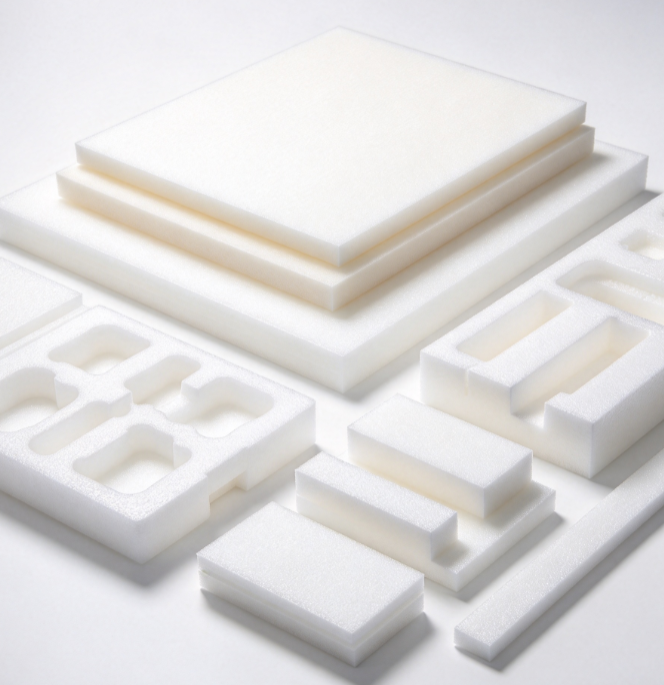
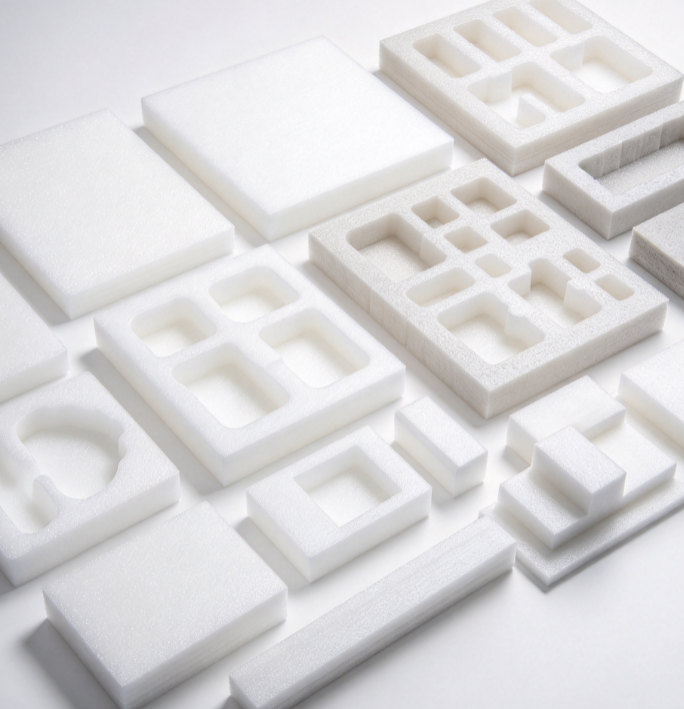
For EPE foam used in protective packaging — case inserts, trays, dunnage, and cushioning — the packaging is classified as non-contact-sensitive plastic. The 2030 target is 35% PCR content. The 2040 target is 65%.
The calculation method. Recycled content is calculated as an average per manufacturing plant and calendar year for each packaging type and format. This means you do not need every individual foam part to hit 35%. You need the average across all EPE foam packaging produced at a given plant in a given year to hit 35%. This averaging approach provides flexibility — higher PCR content in some products can offset lower content in others.
The exemptions. A short list of exemptions applies: medicinal products and medical devices, infant formula packaging, compostable plastics, dangerous goods transport packaging, and any plastic component representing less than 5% of the total weight of the packaging unit. For most industrial and consumer goods EPE foam applications, none of these exemptions apply.
The penalties. Packaging that misses the quota from 2030 may not be placed on the market. Unmet quotas also raise EPR fees. Article 7(7) allows EPR producer fees to be modulated according to recycled content share, with higher recycled content leading to lower fees and lower content penalised. In Belgium, Valipac — the EPR scheme for commercial and industrial packaging — pays a bonus of €100 per tonne of recycled material for plastic packaging containing at least 30% post-consumer recycled content, up from €50 per tonne at the scheme's launch in 2022.
3. The Recycled Content Calculation: What Counts and What Does Not
The PPWR definition of recycled content is narrow. It counts only post-consumer plastic waste. Production scrap and pre-consumer waste do not count, regardless of how a supplier's technical data sheet presents them.
This distinction matters for foam procurement. Many EPE foam suppliers offer "recycled" foam that contains post-industrial scrap from their own production. That material is recyclable and reduces waste, but it does not count toward the PPWR recycled content target. The PCR content must come from post-consumer sources — packaging that has been used by a consumer and collected through a recycling system.
The regulation also requires that post-consumer plastic waste imported from outside the EU must meet European standards (or equivalent) for separate collection and recycling plant emissions. For suppliers sourcing PCR material from Asia or other non-EU regions, the documentation burden is higher. The implementing act on calculation and verification methodology is expected by 31 December 2026.
Proving recycled content. Suppliers must evidence the post-consumer recyclate share, and that proof feeds into the PPWR declaration of conformity. Compliance requires specification, supplier evidence, and material traceability. From 1 January 2029, the calculation and verification of recycled content must comply with the adopted methodology.
For procurement teams, this means recycled content data becomes part of the specification. The supplier must provide certified evidence of the PCR share, and that evidence must be traceable through the supply chain. Recycled content percentages must be collected and tracked at the supplier and SKU level.
4. How PCR EPE Foam Is Made
Understanding the manufacturing process explains both the performance data and the production challenges.
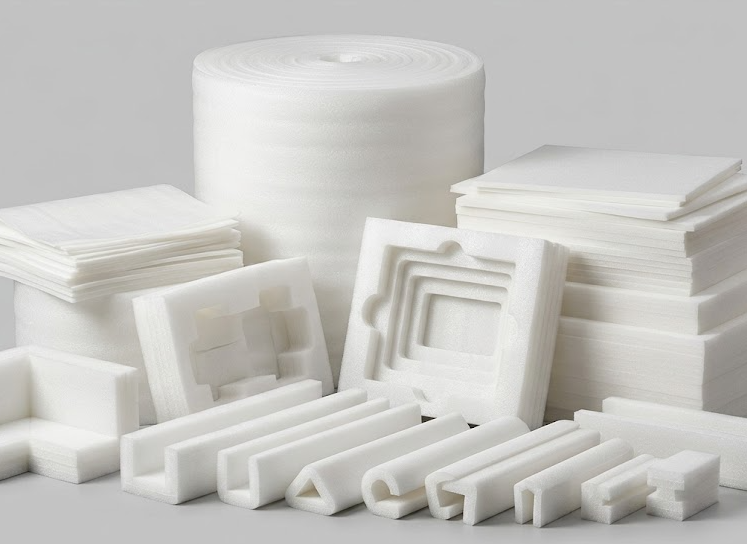
EPE foam is produced by expanding low-density polyethylene beads using a physical blowing agent. The beads are heated, the blowing agent expands the polymer, and the expanded beads are fused together to form the foam block. The process is well-established for virgin material. Introducing PCR content changes the feedstock, not the fundamental process.
The PCR material is collected post-consumer polyethylene — typically from packaging, films, or rigid containers. It is sorted, cleaned, shredded, and processed into pellets or flakes that can be blended with virgin resin. The blend is then fed into the foam extrusion line.
The critical production challenge is contamination. PCR material has higher levels of contaminants than virgin resin — residual inks, labels, adhesives, dirt, and other polymers that were not fully separated during recycling. These contaminants must be filtered out for good foaming results. Achieving higher rates of contamination removal and maintaining melt flow index rates at acceptable levels requires enhanced mixing screw designs and better filtration processes without losing cost-effectiveness, productivity, quality, and product safety.
The industry is making progress. European EPE foam producers are now successfully extruding foam sheet with 15% PCR content, and the technology is being developed to increase that amount. A commercially available PCR EPE foam product contains 25% post-consumer recycled polyethylene and is described as having "excellent shock absorption and repeated shock resistance," isotropic energy absorption across all three planes, and stable performance from -60°C to +100°C.
PCR EPE Foam Parameter | Typical Value |
PCR content (commercial) | 25% |
PCR content (demonstrated in testing) | 30–40% |
Density | 45 kg/m³ |
Compressive strength at 25% strain | 120 kPa |
Compressive strength at 50% strain | 200 kPa |
Tensile strength | 550 kPa |
Compression set (25%, 24h) | 4% |
Shore 00 hardness | 72 |
Service temperature | -60°C to +100°C |
Flammability | FMVSS302 PASS |
Source: Peregrine MLS PCR Foam datasheet
5. Mechanical Performance: Does PCR Foam Match Virgin?
This is the question that determines whether the conversion is feasible. And the data answers it clearly: for moderate PCR content, yes.
The Cal Poly study. The most rigorous published evaluation of recycled-content EPE foam performance is the 2026 study by Singh et al. at California Polytechnic State University, published in Packaging Technology and Science. The study evaluated EPE foams with 0%, 30%, and 40% recycled content under controlled impact conditions following ASTM D1596 — the standard test method for dynamic cushioning performance of packaging materials. A total of 1,100 drop tests were conducted across combinations of density, thickness, static load, and drop height.
The primary performance response was peak transmitted acceleration — the G-force that reaches the product during an impact. Lower peak acceleration means better cushioning. The results showed that recycled-content EPE foams exhibited cushioning performance comparable to virgin materials. The 30% recycled-content formulation was associated with lower mean peak transmitted accelerations and reduced variance relative to virgin foam. The study notes that these differences are configuration-dependent and should not be interpreted as a universal performance improvement, but the overall finding is unambiguous: 30% recycled content does not compromise protective performance.
Multivariate regression analysis identified recycled content as a statistically significant predictor of reduced peak acceleration after controlling for geometry, density, drop height, and static load. Thickness and impact severity remained the dominant determinants of cushioning behaviour. Increasing thickness from 2.5 cm to 5.1 cm reduced peak acceleration by more than 70 G, underscoring that geometric design plays a larger role in shock mitigation than recycled content level.
The practical interpretation. For protective packaging applications that currently use virgin EPE foam, a 30% PCR formulation is a drop-in replacement from a performance standpoint. The cushioning curves are comparable. The G-levels transmitted to the product are comparable or better. The design does not need to change.
At 40% PCR content, the study also showed comparable performance, but with more configuration-dependent results. The 30% level is the sweet spot for commercial conversion: high enough to contribute meaningfully toward the 35% PPWR target, low enough to maintain consistent foam quality.
Performance Metric | Virgin EPE | 30% PCR EPE | 40% PCR EPE |
Cushioning performance | Baseline | Comparable or better | Comparable |
Peak transmitted acceleration | Baseline | Lower mean, reduced variance | Configuration-dependent |
Compression set | 7% | 4–7% | 5–8% |
Density range | 15–60 kg/m³ | 15–60 kg/m³ | 15–60 kg/m³ |
Thickness | Standard | Standard | Standard |
Design change required | N/A | None | Minor validation recommended |
6. Head-to-Head: Complete Specification Comparison Table
Parameter | Virgin EPE Foam | PCR EPE Foam (25–30%) | High-PCR EPE Foam (40%+) |
PCR content | 0% | 25–30% | 40%+ |
PPWR 2030 compliance (35% target) | Non-compliant | Partial — averaging required | Compliant |
Cushioning performance | Baseline | Comparable | Comparable — configuration-dependent |
Compression set (25%, 24h) | 7% | 4–7% | 5–8% |
Density | 15–60 kg/m³ | 15–60 kg/m³ | 15–60 kg/m³ |
Cell structure | Semi-closed (60–80%) | Semi-closed (60–80%) | Semi-closed (60–80%) |
Off-gassing | None | None | None |
Recyclability | 100% recyclable | 100% recyclable | 100% recyclable |
Contamination risk | None | Moderate | Higher |
Processing difficulty | Standard | Moderate | Higher |
Supply availability | Wide | Growing | Limited |
Relative cost | Baseline | +5–15% | +15–30% |
EPR fee impact | Higher fees | Reduced fees | Lowest fees |
Best application | Non-EU markets | EU market — current transition | EU market — long-term |
7. Contamination and Processing: The Real Production Challenge
The performance data says 30% PCR is a drop-in replacement. The production reality is more complicated. The gap between the two is contamination.
PCR polyethylene comes from post-consumer collection systems. It contains residual inks from printed films, adhesive residues from labels, dirt from the collection stream, and trace amounts of other polymers that were not perfectly separated. These contaminants must be filtered out before the material can be foamed. The filtration challenge is not trivial — EPE foam is demanding enough to foam with virgin material, and PCR introduces contamination levels that require enhanced mixing and continuous melt filtration technology.
Melt flow index stability. The melt flow index (MFI) of the PCR feedstock can vary from batch to batch because the source material varies. Virgin resin has a tightly controlled MFI. PCR resin does not. Maintaining MFI within the narrow window required for consistent foam expansion requires real-time monitoring and process adjustment.
Foam density consistency. Variation in the PCR feedstock affects the foam density. A batch of PCR material with higher contamination levels may produce foam that is denser or less uniform than the target. The density uniformity that EPE is known for — consistent from surface to core — must be verified for each production lot.
Practical mitigation. The industry is addressing these challenges through improved mixing screw designs, better filtration processes, and continuous melt filtration technology. For buyers, the practical mitigation is to qualify suppliers who have demonstrated stable PCR foam production, to require density and compression set data for each production lot, and to specify the acceptable variation range rather than a single nominal value.
The key takeaway for procurement is that PCR EPE foam is not a commodity. The quality varies with the supplier's contamination control and process capability. A supplier who has invested in melt filtration and mixing technology will deliver consistent foam. A supplier who has not will deliver foam that passes the first sample and fails the fifth production run.
8. Cost Analysis: PCR Premium vs. EPR Fee Savings
The cost equation for PCR EPE foam has two sides: the material premium and the EPR fee reduction.
The material premium. PCR EPE foam currently costs approximately 5–15% more than virgin EPE foam at 25–30% PCR content, depending on the supplier and the volume. The premium reflects the cost of collecting, sorting, cleaning, and processing PCR feedstock, plus the additional filtration and process control required to produce consistent foam. At 40%+ PCR content, the premium rises to 15–30% because the processing challenges increase and the supply of high-quality PCR feedstock is more limited.
The EPR fee reduction. Article 7(7) of the PPWR allows EPR fees to be modulated according to recycled content share. Higher recycled content means lower fees. In Belgium, Valipac pays a bonus of €100 per tonne of recycled material for plastic packaging containing at least 30% post-consumer recycled content. Other national EPR schemes are implementing similar modulation.
The compliance cost of non-compliance. Packaging that misses the 2030 quota may not be placed on the EU market. For a manufacturer whose entire EU distribution depends on EPE foam packaging, non-compliance is not a cost issue — it is a market access issue.
The breakeven calculation. For a manufacturer using 100 tonnes of EPE foam annually in EU packaging:
·
Material premium at 10% over a baseline of €2,000/tonne = €20,000 per year
·
·
EPR fee reduction at €100/tonne for 30% recycled content = €10,000 per year
·
·
Net additional cost = €10,000 per year
·
·
Value of maintaining EU market access = not quantifiable in cost terms
·
The premium is real but manageable. And for many manufacturers, the EPR fee reduction offsets a significant portion of the material premium. The net cost of compliance is a fraction of the cost of losing market access.
9. Case Study: A Consumer Goods Manufacturer's 12% to 35% Conversion
The most instructive scenario for PCR EPE foam conversion comes from a consumer goods manufacturer that converted its plastic shipping packaging to recyclate-based material ahead of the 2030 deadline.
The starting point. The manufacturer used EPE foam inserts for protective packaging of household appliances distributed across the EU. The average recycled content across the packaging portfolio was 12%. The EPR fees were at the baseline level. The 2030 PPWR target for non-contact-sensitive plastic was 35%.
The conversion process. The procurement team qualified two additional recyclate suppliers to secure supply and price stability. They anchored minimum recycled content quotas in the framework contracts with their existing foam suppliers. They raised the average recycled content from 12% to 35% across the packaging portfolio — meeting the 2030 target five years early.
The results. The manufacturer qualified two certified recyclate sources. The EPR fees were lowered through higher recyclability and recycled content. The cushioning performance of the PCR foam inserts was validated through drop testing and matched the virgin foam performance. The product damage rate did not increase.
The lesson for B2B buyers. The conversion was not a single material swap. It was a supply chain project: qualifying new suppliers, anchoring quotas in contracts, and validating performance. The manufacturers who start this process in 2026 — when the PPWR becomes applicable — will have four years to complete the transition before the 2030 deadline. Those who wait until 2029 will be competing for a limited supply of certified PCR feedstock.
10. The Selection Decision Matrix
Market / Requirement | PCR Content | Recommended Foam | Rationale |
EU market, 2030 deadline, protective packaging | 30% | PCR EPE (25–30%) | Drop-in performance, partial PPWR compliance |
EU market, 2030 deadline, averaging strategy | 30–40% blend | PCR EPE (variable by SKU) | Higher PCR in some SKUs offsets lower in others |
EU market, 2040 target planning | 40%+ | High-PCR EPE | Building supply chain for 65% target |
Non-EU market, no recycled content mandate | 0% | Virgin EPE | No regulatory driver |
Non-EU market, brand sustainability commitment | 25–30% | PCR EPE | Voluntary recycled content for brand positioning |
Contact-sensitive packaging (food) | 10% | PCR EPE (10%) | Lower threshold for contact-sensitive |
High-value product, zero performance compromise | 25% | PCR EPE (25%) | Validated performance, lower contamination risk |
Cost-sensitive, EU market | 30% | PCR EPE (30%) | Minimum for EPR fee modulation |
11. Practical Sourcing Framework for B2B Buyers
If you are sourcing EPE foam for the EU market, here is the framework I recommend.
Step 1: Determine your recycled content target. For non-contact-sensitive EPE foam packaging placed on the EU market, the 2030 target is 35% PCR content, calculated as an average per manufacturing plant and calendar year. If your product range includes multiple foam SKUs, you can blend higher and lower PCR content to achieve the average.
Step 2: Verify the PCR content definition. The PPWR counts only post-consumer recycled content. Post-industrial scrap does not count. Require your supplier to provide documentation that the PCR content is derived from post-consumer sources and meets the European standards for separate collection and recycling.
Step 3: Validate cushioning performance with drop testing. The Cal Poly study demonstrates that 30% PCR EPE delivers comparable cushioning to virgin. But the performance should be validated for your specific product weight, fragility, and distribution hazards. Require a drop test per ASTM D1596 with the production PCR foam and the actual product.
Step 4: Specify density and compression set for each production lot. PCR feedstock variability can affect foam density and compression set. Require the supplier to provide density and compression set data for each production lot, and specify the acceptable variation range.
Step 5: Qualify multiple PCR suppliers. The supply of certified post-consumer recyclate is limited. Qualifying two or three suppliers reduces the risk of supply interruption and gives you price leverage. Multi-year supply agreements reduce the risk of short-term shortages and price spikes.
Step 6: Anchor recycled content quotas in contracts. The PPWR recycled content requirement is a specification, not a preference. Anchoring minimum recycled content in supply specifications and contracts ensures the supplier is obligated to deliver compliant material.
Step 7: Track recycled content at the SKU level. The PPWR compliance calculation requires recycled content percentages at the supplier and SKU level. Build this tracking into your procurement system now, before the reporting requirement becomes mandatory.
Sourcing Parameter | Virgin EPE | PCR EPE (25–30%) |
PCR content certification | Not required | Required — post-consumer source |
Drop test validation | Standard | Required — ASTM D1596 |
Density data per lot | Recommended | Required |
Compression set data per lot | Recommended | Required |
Supply chain qualification | Single supplier acceptable | Multiple suppliers recommended |
Contractual quota | Not applicable | Minimum PCR % anchored |
EPR fee tracking | Baseline | Tracked for modulation |
12. Frequently Asked Questions
Q: What does the EU PPWR require for EPE foam packaging?
From 1 January 2030, non-contact-sensitive plastic packaging placed on the EU market must contain at least 35% post-consumer recycled content, calculated as an average per manufacturing plant and calendar year. The target rises to 65% by 2040. Packaging that misses the quota may not be placed on the market.
Q: Does PCR EPE foam perform as well as virgin EPE foam?
For 30% PCR content, yes. The 2026 Cal Poly study of 1,100 drop tests found that recycled-content EPE foams exhibited cushioning performance comparable to virgin materials, and the 30% formulation was associated with lower mean peak transmitted accelerations and reduced variance. Performance at 40% PCR content is also comparable, but more configuration-dependent.
Q: What is the difference between post-consumer and post-industrial recycled content?
Post-consumer recycled content comes from packaging or products that have been used by a consumer and collected through a recycling system. Post-industrial recycled content comes from manufacturing scrap. Only post-consumer content counts toward the PPWR recycled content target.
Q: How much more does PCR EPE foam cost than virgin EPE foam?
PCR EPE foam at 25–30% recycled content costs approximately 5–15% more than virgin EPE foam. At 40%+ recycled content, the premium rises to 15–30% due to higher processing challenges and limited feedstock supply.
Q: Can PCR EPE foam be recycled at end of life?
Yes. PCR EPE foam is 100% recyclable, the same as virgin EPE foam. The PCR content is post-consumer polyethylene that has already been through one recycling cycle, and the foam can be collected and recycled again.
Q: What are the exemptions from the PPWR recycled content requirement?
Exemptions include medicinal products and medical devices, infant formula packaging, compostable plastics, dangerous goods transport packaging, and any plastic component representing less than 5% of the total weight of the packaging unit.
Q: How is recycled content calculated for compliance?
Recycled content is calculated as an average per manufacturing plant and calendar year for each packaging type and format. This means you do not need every individual foam part to hit 35% — the average across all EPE foam packaging produced at a given plant in a given year must hit 35%.
Q: What documentation do I need from my supplier?
Suppliers must provide evidence of the post-consumer recyclate share. This evidence feeds into the PPWR declaration of conformity. From 1 January 2029, the calculation and verification must comply with the adopted methodology. Require your supplier to provide certified recycled content documentation at the SKU level.
13. Final Thoughts
Let me leave you with this.
The PPWR recycled content requirement is not a sustainability aspiration. It is a market access condition. From 1 January 2030, EPE foam packaging placed on the EU market must contain an average of 35% post-consumer recycled content, or it cannot be legally placed on the market. The manufacturers who start the conversion now have four years to qualify suppliers, validate performance, and anchor quotas in contracts. Those who wait until 2029 will be competing for a limited supply of certified PCR feedstock.
The data is clear. The 2026 Cal Poly study of 1,100 drop tests demonstrates that 30% PCR EPE foam delivers cushioning performance comparable to virgin foam, with the 30% formulation showing lower mean peak transmitted accelerations and reduced variance in the tested configurations. Commercial PCR EPE foam products at 25% recycled content are available now, with performance specifications including 120 kPa compressive strength at 25% strain, 4% compression set, and stable operation from -60°C to +100°C.
The challenges are real — contamination control, melt flow index variability, and density consistency — but they are production challenges, not performance barriers. The industry is addressing them with enhanced filtration and mixing technology, and the supply of certified PCR feedstock is growing.