Why More Manufacturers Are Choosing EPE Foam Sheets in 2026
Table of Contents
1. Why EPE Foam Sheets Continue to Gain Market Share
2. What Are EPE Foam Sheets?
3. How EPE Foam Sheets Are Manufactured
4. The Material Properties Behind Their Popularity
5. Where EPE Foam Sheets Are Used Today
6. Selecting the Right Density and Thickness
7. Quality Standards and Performance Testing
8. Industry Case Study
9. Frequently Asked Questions
10. Final Thoughts
Walk Into Almost Any Factory…
Spend a few hours inside an electronics factory.
Then visit a furniture manufacturer.
Next, stop by an automotive parts supplier.
The products couldn't be more different.
Yet you'll probably notice something surprisingly familiar.
Stacks of white EPE Foam Sheets waiting beside production lines.
That's no coincidence.
Over the last decade, manufacturers haven't simply continued using expanded polyethylene foam—they've found more reasons to depend on it.
Products have become lighter.
Components have become more delicate.
Global shipping routes have become longer.
Customer expectations have become much higher.
Packaging materials have had to evolve alongside those changes.
Today, protective packaging isn't judged only by whether it prevents damage. Manufacturers also expect packaging to improve automation, reduce transportation costs, simplify assembly, and support sustainability goals.
That shift explains why EPE Foam Sheets have become a standard material across industries ranging from consumer electronics to medical equipment.
They're no longer viewed as simple cushioning foam.
They're part of modern product protection engineering.
What Are EPE Foam Sheets?
EPE Foam Sheets, short for Expanded Polyethylene Foam Sheets, are lightweight, closed-cell polyethylene foam materials produced through an extrusion foaming process.
At first glance, the material looks simple.
Tiny closed air cells.
Soft texture.
Bright white appearance.
But its internal structure is what gives it exceptional performance.
Each microscopic closed cell traps air inside the material.
Those trapped air pockets absorb impact energy, reduce vibration, and distribute pressure evenly across the surface.
That's why the material performs remarkably well during transportation.
Instead of allowing shock to transfer directly to the product, the foam dissipates much of the energy before it reaches the item being protected.
The result?
Better protection without excessive material weight.
Why Closed-Cell Structure Matters
Not every foam performs the same way.
One of the biggest advantages of closed-cell polyethylene foam sheets is that the cells remain sealed rather than interconnected.
That seemingly small difference creates several practical benefits.
Closed-cell construction helps the material:
· Resist water absorption
· Maintain consistent cushioning performance
· Improve thermal insulation
· Reduce moisture penetration
· Increase durability during repeated handling
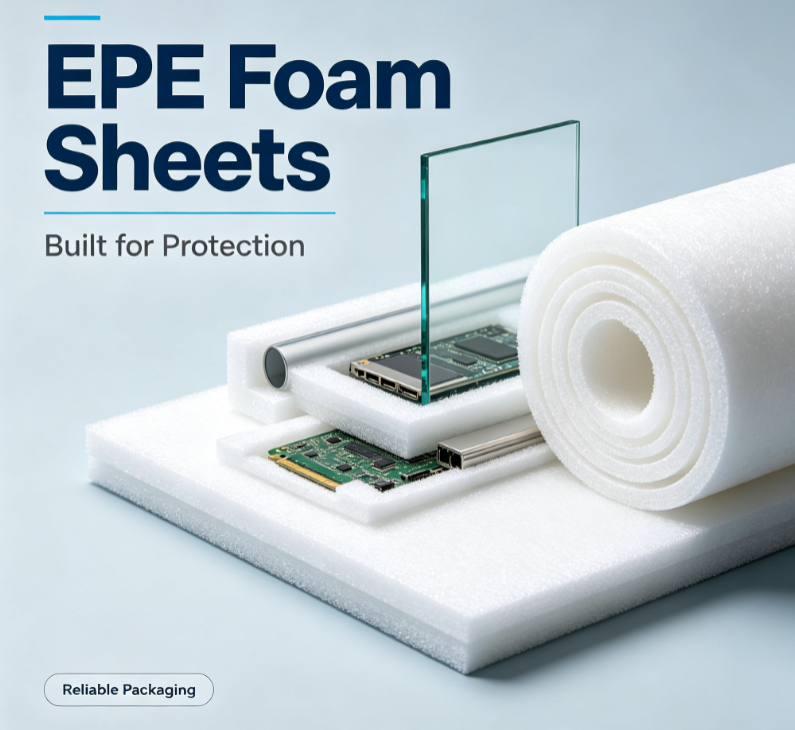
This is why EPE is widely selected for packaging electronic devices, precision instruments, glass products, household appliances, and industrial components.
How Are EPE Foam Sheets Manufactured?
Many buyers know how the finished material looks.
Far fewer understand how it's made.
The manufacturing process begins with low-density polyethylene (LDPE) resin.
During extrusion, the molten polymer is mixed with a foaming agent under carefully controlled temperature and pressure.
As the material exits the extrusion die, millions of microscopic cells expand rapidly.
Those cells create the familiar lightweight foam structure.
Depending on the intended application, manufacturers may further process the material through:
· Lamination
· Heat bonding
· CNC cutting
· Die cutting
· Hot wire cutting
· Thermoforming
· Surface embossing
These secondary operations allow standard EPE Foam Sheets to become highly customized protective packaging solutions.
A simple foam sheet can eventually become:
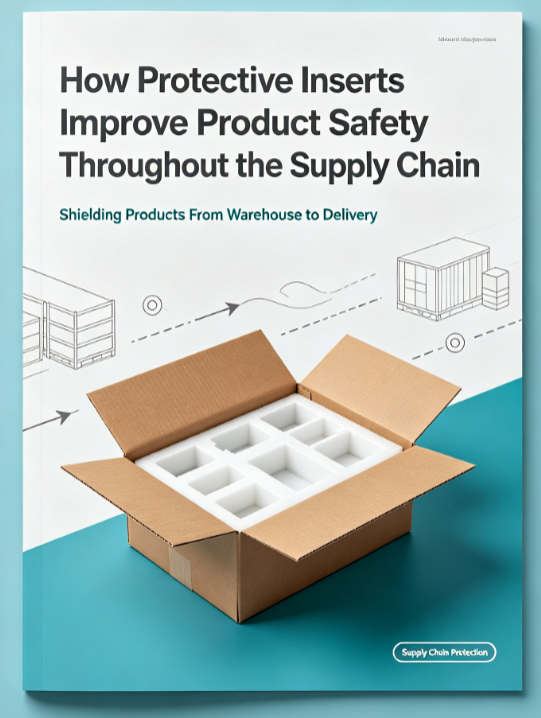
· Protective inserts
· Edge protectors
· Corner guards
· Tool trays
· Medical packaging
· Electronics packaging
· Automotive component supports
That's one reason EPE remains so versatile.
Why Manufacturers Continue Choosing EPE Foam Sheets
Every packaging material solves a different problem.
Corrugated cardboard provides structure.
Plastic films offer sealing.
Wooden crates provide strength.
EPE Foam Sheets specialize in something equally important:
Protecting products from impact while adding very little weight.
Several material characteristics explain why manufacturers continue choosing EPE.
Outstanding Cushioning Performance
Transportation exposes products to continuous vibration, accidental drops, stacking pressure, and sudden impacts.
A rigid package transfers most of that energy directly to the product.
EPE behaves differently.
Its resilient cellular structure compresses during impact before returning close to its original shape.
That recovery characteristic allows many high-density EPE foam sheets to withstand repeated compression without permanent deformation.
For manufacturers shipping thousands of products every week, reducing even a small percentage of transportation damage can translate into substantial savings.
Lightweight Without Sacrificing Protection
Shipping costs rarely decrease.
If anything, they're becoming more sensitive to package weight and dimensional efficiency.
One advantage of EPE foam packaging sheets is their exceptionally low density.
Despite being mostly air, they still provide reliable cushioning performance.
Less packaging weight often means:
· Lower freight costs
· Easier manual handling
· Improved warehouse efficiency
· Reduced packaging material consumption
For export-oriented manufacturers, those savings accumulate surprisingly quickly.
Excellent Moisture Resistance
Some packaging materials lose strength after exposure to humidity.
Paper absorbs water.
Certain fiber materials soften over time.
Closed-cell EPE performs differently.
Because the cells remain sealed, the material absorbs very little water under normal conditions.
That makes it suitable for products stored in warehouses, transported internationally, or exposed to varying climates.
Moisture resistance also helps maintain consistent cushioning performance throughout the logistics process.
Reliable Thermal Insulation
Although primarily known for protective packaging, EPE Foam Sheets also provide useful thermal insulation.
The trapped air inside each closed cell slows heat transfer.
For this reason, EPE is sometimes used in applications including:
· Cold-chain transportation support
· Construction insulation
· HVAC systems
· Refrigeration equipment
· Temperature-sensitive packaging
While it isn't a replacement for specialized insulation materials in every application, its thermal performance adds another layer of versatility.
Easy to Fabricate
Packaging engineers appreciate materials that are easy to work with.
EPE can be converted into complex shapes using relatively efficient manufacturing processes.
Whether the requirement is a simple protective pad or a precision-cut insert for fragile electronics, the material adapts well to automated fabrication.
Common converting methods include:
· CNC routing
· Waterjet cutting
· Laminating
· Heat sealing
· Die cutting
· Adhesive bonding
That flexibility allows manufacturers to create custom EPE foam sheets tailored to almost any product geometry.
More Than Packaging—A Manufacturing Material
One misconception is that EPE only belongs in shipping cartons.
Not anymore.
Today, manufacturers also use protective packaging foam throughout production itself.
For example:
During assembly, foam sheets protect finished surfaces from scratches.
Between machining operations, they separate precision components.
Inside warehouses, they reduce abrasion during storage.
Even temporary work-in-progress packaging often relies on EPE because it can be reused multiple times before replacement.
The material has quietly become part of manufacturing efficiency—not just transportation.
Sustainability Is Becoming Part of the Conversation
Ask packaging engineers what clients requested ten years ago.
Most conversations focused on protection and cost.
Today?
Sustainability almost always enters the discussion.
Manufacturers increasingly ask whether recyclable EPE foam can fit within broader environmental objectives.
While EPE is still a petroleum-based material, it offers several advantages from a lifecycle perspective.
It is lightweight, which can reduce transportation emissions.
It is durable enough for reuse in returnable packaging systems.
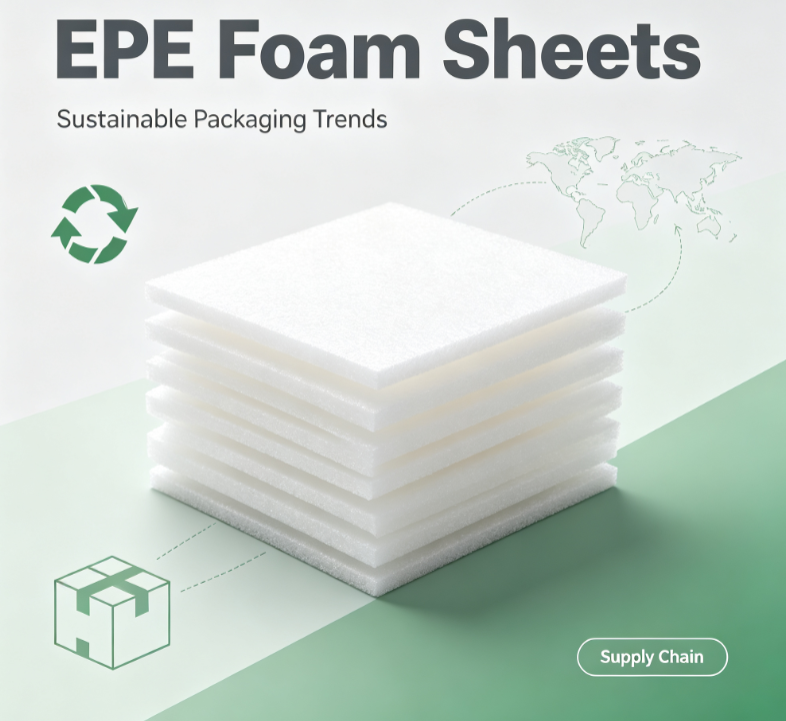
And in many regions, clean polyethylene foam can be collected and recycled into new plastic products through established recycling streams.
As companies work toward reducing waste and improving packaging efficiency, these characteristics are becoming more relevant than ever.
Understanding the Technical Performance of EPE Foam Sheets
By now, it's clear that EPE Foam Sheets are lightweight and versatile.
But that's only part of the story.
What keeps manufacturers using them year after year isn't simply that they're easy to handle. It's that their mechanical properties can be adjusted to match very different products—from a delicate smartphone camera module to a 30-kilogram industrial motor.
That's where engineering starts to matter.
Density: The Specification That Influences Everything
Ask ten buyers what specification they pay attention to first.
Many will answer, "Thickness."
In reality, density often has a greater impact on protective performance.
Density determines how much polyethylene material exists within a given volume of foam. As density increases, the foam generally becomes firmer, stronger, and more resistant to repeated compression.
Selecting the wrong density can create two very different problems.
If the foam is too soft, it may bottom out during impact and fail to protect the product.
If it's unnecessarily dense, manufacturers may end up paying more for material without gaining meaningful performance.
Finding the balance is the goal.
Typical Density Ranges
Although exact specifications vary by manufacturer, most high-density EPE foam sheets fall within these general ranges:
Density | Typical Performance | Common Applications |
18–22 kg/m³ | Lightweight cushioning | Disposable packaging, lightweight consumer goods |
23–30 kg/m³ | General-purpose protection | Home appliances, furniture, household products |
30–45 kg/m³ | Higher compression resistance | Electronics, industrial equipment, precision instruments |
45 kg/m³ and above | Heavy-duty protection | Automotive components, machinery, reusable packaging systems |
Higher density doesn't automatically mean "better."
It simply means the material behaves differently under load.
Experienced packaging engineers normally determine density after evaluating:
· Product weight
· Drop height
· Transportation conditions
· Product fragility
· Packaging configuration
Thickness Should Match the Product, Not the Budget
Thickness is another specification that buyers frequently compare.
Again, thicker isn't always better.
An oversized foam insert may increase shipping costs without providing additional protection.
Conversely, a sheet that's too thin may compress completely during impact.
Typical EPE Foam Sheets are available in thicknesses ranging from 2 mm to more than 100 mm, depending on the manufacturing process and lamination requirements.
Thin sheets often serve as:
· Surface protection
· Scratch prevention
· Layer separation
Medium-thickness sheets are widely used for:
· Consumer electronics
· Furniture packaging
· Glass products
· Household appliances
Thicker laminated structures are generally selected for:
· Industrial machinery
· Medical equipment
· Precision instruments
· Export packaging
The correct thickness depends on the product's cushioning requirements—not on a universal standard.
Compression Recovery: Why EPE Performs Well Over Time
One reason manufacturers continue specifying closed-cell polyethylene foam sheets is their ability to recover after compression.
When subjected to moderate pressure, EPE compresses to absorb energy and then rebounds close to its original shape.
This recovery characteristic provides several practical advantages:
· Better repeated-use performance
· Reduced permanent deformation
· Longer service life in returnable packaging
· Consistent cushioning during transportation
For companies operating reusable packaging systems, this durability can significantly reduce replacement frequency.
Water Resistance Makes Global Shipping Easier
International logistics present unpredictable conditions.
Ocean freight.
Container condensation.
Seasonal humidity.
Long warehouse storage.
These factors can quickly degrade some packaging materials.
EPE behaves differently because its closed-cell structure absorbs very little moisture under normal conditions.
This helps maintain:
· Stable cushioning performance
· Dimensional consistency
· Product cleanliness
· Long-term storage reliability
For exporters shipping products across multiple climate zones, that stability becomes an important advantage.
Anti-Static EPE Foam Sheets for Sensitive Electronics
Not every product only needs physical protection.
Electronic components also require protection from electrostatic discharge (ESD).
Static electricity may seem harmless to people.
For integrated circuits and precision electronics, however, even relatively small electrostatic discharges can damage sensitive components.
To address this risk, manufacturers often specify anti-static EPE foam sheets.
These materials contain additives that reduce static charge accumulation during handling and transportation.
Common applications include:
· Printed circuit boards (PCB)
· Semiconductor devices
· Medical electronics
· Communication equipment
· Consumer electronics
· Automotive electronic modules
Anti-static foam doesn't replace complete ESD protection systems.
Instead, it becomes one important layer within a broader electrostatic control strategy.
Lamination Expands Design Possibilities
One of EPE's biggest strengths is its flexibility during fabrication.
Individual foam sheets can be laminated together to produce thicker structures or combine different material characteristics.
Laminated EPE foam packaging sheets allow manufacturers to create:
· Precision-cut inserts
· Multi-layer cushioning systems
· Heavy-duty protective blocks
· Custom product trays
· Tool storage solutions
Lamination also improves structural stability for products requiring deeper cavities or more complex protective geometries.
Fabrication Techniques Continue to Improve
Packaging today isn't limited to simple rectangular foam pads.
Modern converting equipment allows manufacturers to produce highly customized protective solutions with excellent dimensional accuracy.
Common fabrication methods include:
CNC Cutting
Suitable for prototypes, small batches, and precision industrial packaging where flexibility is important.
Die Cutting
Ideal for high-volume production requiring consistent dimensions and repeatability.
Hot Wire Cutting
Frequently used for thicker foam blocks and specialized shapes.
Adhesive Bonding
Multiple foam components can be assembled into complete protective packaging systems.
Heat Lamination
Creates thicker, stronger structures while maintaining excellent cushioning performance.
These fabrication capabilities explain why custom EPE foam sheets have become increasingly common across manufacturing industries.
Quality Testing Should Never Be Overlooked
Two foam sheets may look almost identical.
That doesn't mean they'll perform the same.
Professional manufacturers routinely evaluate material properties before approving production.
Typical testing includes:
Test Item | Why It Matters |
Density Verification | Confirms material consistency |
Compression Strength | Measures resistance under load |
Compression Set | Evaluates recovery after long-term pressure |
Tensile Strength | Assesses material durability |
Elongation at Break | Indicates flexibility |
Water Absorption | Verifies moisture resistance |
Dimensional Accuracy | Ensures consistent fabrication |
Surface Quality Inspection | Detects manufacturing defects |
Testing helps ensure that packaging performs consistently—not only during laboratory evaluation but throughout real-world logistics.
Real Industry Case: Consumer Electronics Manufacturing
Few industries place higher demands on protective packaging than consumer electronics.
Products are lightweight but extremely sensitive to shock, vibration, and cosmetic damage.
Companies such as Apple, Samsung, Dell, and many of their contract manufacturing partners—including Foxconn—have long relied on engineered polyethylene foam solutions throughout various stages of manufacturing and distribution. While packaging designs vary by product and supplier, expanded polyethylene foam is widely used across the electronics industry for protective inserts, tray systems, and transport packaging because of its combination of cushioning, low weight, and fabrication flexibility.
The lesson isn't that one material fits every application.
It's that successful manufacturers design protective packaging around measurable performance requirements rather than assumptions.
That engineering-first approach explains why EPE Foam Sheets remain one of the most widely specified cushioning materials in global manufacturing.
An Engineer's Perspective
I've seen projects where companies spent weeks negotiating foam prices...
...only to discover later that transportation damage cost far more than the savings.
Packaging materials shouldn't be selected in isolation.
The best results come from evaluating the complete system:
· Product characteristics
· Shipping conditions
· Production efficiency
· Automation requirements
· Sustainability goals
· Long-term operating costs
Once those factors are considered together, the "right" foam specification usually becomes much easier to identify.
How to Choose the Right EPE Foam Sheet Manufacturer
Once you've determined the right density, thickness, and fabrication method, the next decision is just as important.
Who will manufacture it?
This is where many purchasing projects succeed—or quietly run into problems months later.
On paper, two suppliers may look almost identical. Both can produce EPE Foam Sheets, both offer customization, and both provide competitive pricing.
The difference usually appears after production begins.
Can they maintain consistent density across every batch?
Will the dimensions remain within tolerance after thousands of pieces?
Can they support design optimization instead of simply manufacturing to a drawing?
Those questions matter far more than saving a few cents per sheet.
Manufacturing Experience Is More Than Production Capacity
A factory with multiple extrusion lines isn't automatically the better choice.
For industrial buyers, manufacturing capability should include technical support as well as production volume.
An experienced EPE foam sheet manufacturer should be able to assist with:
· Material selection based on product weight and fragility
· Cushioning design optimization
· CNC and die-cutting recommendations
· Prototype development
· Packaging validation
· Export packaging solutions
· Consistent batch quality
In other words, you're looking for an engineering partner—not just a foam supplier.
Quality Control Starts Before Production
Good foam doesn't happen by accident.
It begins with raw material consistency and continues through every stage of manufacturing.
Professional manufacturers typically implement quality inspections covering:
Raw Material Verification
Incoming polyethylene resin is checked for consistency before extrusion begins.
This helps minimize density fluctuations and maintains stable mechanical performance.
Process Monitoring
During extrusion and foaming, operators monitor key production parameters such as:
· Foam density
· Cell structure uniformity
· Thickness tolerance
· Sheet width
· Surface smoothness
· Color consistency
Even minor variations can affect cushioning performance.
Finished Product Testing
Before shipment, finished EPE Foam Sheets are commonly tested for:
· Density
· Compression strength
· Compression recovery
· Water absorption
· Dimensional accuracy
· Visual defects
· Packaging integrity
Reliable manufacturers keep detailed inspection records, allowing customers to trace production if quality questions arise later.
Common Mistakes Buyers Make
Interestingly, most packaging issues aren't caused by defective foam.
They're caused by incomplete specifications.
Here are several mistakes that appear surprisingly often.
Choosing Density Based Only on Cost
Lower-density foam usually costs less.
That makes it tempting.
But if the product requires higher impact resistance, selecting a softer material may increase shipping damage, customer complaints, and replacement costs.
The cheapest material isn't always the lowest-cost solution.
Ignoring Real Shipping Conditions
Many packaging designs are evaluated under ideal laboratory conditions.
Real logistics look very different.
Products experience:
· Forklift handling
· Truck vibration
· Ocean freight
· Long-term warehouse storage
· Repeated loading and unloading
Protective packaging should be designed for actual transportation—not perfect conditions.
Forgetting Automation Requirements
Modern production lines move quickly.
If foam inserts don't fit consistently or vary slightly in dimension, automated equipment may slow down or stop entirely.
Precision manufacturing improves more than packaging quality—it also improves production efficiency.
Waiting Too Long to Prototype
A CAD drawing is helpful.
A physical prototype is better.
Testing a prototype before mass production often reveals opportunities to:
· Reduce material usage
· Improve cushioning
· Simplify assembly
· Increase packing speed
· Lower logistics costs
Small adjustments made early are much less expensive than redesigning finished packaging.
Why EPE Foam Sheets Continue to Gain Popularity in 2026
Several long-term trends are driving wider adoption of EPE Foam Sheets across manufacturing industries.
The first is product complexity.
Electronics are becoming smaller.
Medical devices are becoming more precise.
Automotive components now integrate sensors, cameras, and electronic control units that require greater protection during transportation.
The second trend is automation.
Factories increasingly rely on automated packaging systems that require materials with consistent dimensions and repeatable performance.
The third is sustainability.
Manufacturers are under growing pressure to reduce packaging waste without sacrificing product protection.
Because EPE is lightweight, reusable in many applications, and recyclable where suitable collection systems exist, it continues to fit many companies' broader packaging strategies.
According to Smithers, fiber-based and lightweight protective packaging solutions are expected to remain major areas of investment as manufacturers seek to optimize logistics costs while improving sustainability performance. At the same time, organizations such as the Association of Plastic Recyclers (APR) continue to expand guidance for improving plastics recycling infrastructure and design compatibility.
The direction is clear.
Packaging materials will need to become lighter, smarter, and more resource-efficient.
EPE remains well positioned within that transition.
Frequently Asked Questions
Are EPE Foam Sheets recyclable?
Yes. EPE Foam Sheets are made from polyethylene, a recyclable thermoplastic. In regions with appropriate collection and recycling systems, clean EPE foam can be processed into recycled plastic products. Recycling availability depends on local infrastructure and regulations.
What density should I choose for protective packaging?
There isn't a universal answer.
The appropriate density depends on several factors, including:
· Product weight
· Fragility
· Shipping distance
· Expected drop height
· Packaging configuration
Packaging engineers typically determine density after reviewing transportation requirements rather than selecting it solely by cost.
Can EPE Foam Sheets be customized?
Absolutely.
Modern fabrication technologies allow manufacturers to produce:
· CNC-cut inserts
· Die-cut components
· Laminated blocks
· Corner protectors
· Tool trays
· Anti-static packaging
· Protective dividers
· Custom industrial packaging solutions
Customization is one of the material's biggest strengths.
Are EPE Foam Sheets suitable for electronics packaging?
Yes.
Because of their cushioning performance, low moisture absorption, and availability in anti-static EPE foam sheet grades, they are widely used throughout the electronics industry for protecting sensitive components during manufacturing, storage, and transportation.
Final Thoughts
There is a reason EPE Foam Sheets continue to appear in so many industries.
Not because they're the newest material on the market.
Quite the opposite.
They've earned their place through decades of proven performance.
A well-designed EPE solution protects products without adding unnecessary weight. It supports automated production, withstands demanding logistics environments, and can be fabricated into highly customized packaging for everything from precision electronics to heavy industrial equipment.
As manufacturing continues to evolve, packaging is no longer viewed as an afterthought. It has become part of product quality, operational efficiency, and customer satisfaction.
Choosing the right EPE Foam Sheets means looking beyond a specification sheet. Material density, structural design, fabrication quality, supplier expertise, and real-world testing all contribute to the final result.
Manufacturers that take this broader view are often rewarded with fewer shipping claims, smoother production, and stronger long-term value.